
A new catalyst, sorbent, or other functional material shows strong results in the lab. Conversion is high, capacity looks promising, and the data supports the next round of funding or the next internal review.
At that point, the questions shift. How will the material be coated? How should it be characterized and tested so the results hold up in the field? Can the process be repeated as the program moves toward catalyst commercialization?
Technology development is an iterative process of building evidence. Each hypothesis, build cycle, test, and iteration reduces uncertainty, exposes failure modes, and makes the product more robust. Programs move faster when each decision in that loop is based on data collected under conditions close to the final application. The goal is to learn more from every cycle and complete each one sooner. CDTi helps customers gather that evidence early, with engineered coatings for catalyst and sorption-based applications designed around how the material will be used.
Why Early Performance Data Leaves Gaps
Early results usually come from powders or small samples tested under controlled conditions. The final product is a coated part operating in a real system. Many late-stage surprises come from the difference between the two, and closing that gap early makes each later cycle more productive.
That gap can be difficult to close in-house. As AIChE’s Chemical Engineering Progress noted in “Scale Up Heterogeneous Catalysts” (February 2023), much of the know-how behind catalyst scale-up is held as trade secrets and is not widely published. Many organizations that develop and use catalysts do not manufacture them, so a manufacturing partner often becomes part of the development loop well before production.
Material Behavior Changes After Coating
Adhesion, loading, and dispersion on metallic, ceramic, foam, or honeycomb substrates can all affect performance. A formulation optimized as a powder behaves differently once it is applied as a layer with its own porosity, thickness distribution, and thermal mass. Testing the coated form makes the findings from each cycle transferable to the final product.
Test Conditions Rarely Match Operating Conditions
Temperature, flow, contaminants, and pressure drop in the field seldom match a bench test. Cycles run under conditions the product will never see do little to reduce uncertainty. Cycles run under representative conditions answer the questions that matter for the application.
Repeatability Takes More Than One Good Batch
A single successful batch does not show that the process can run at volume with consistent results. Batch-to-batch variation, raw material variability, and coating process windows are all worth testing early, while changes are still inexpensive.
Test the Form You Plan to Ship
Powder data is a useful starting point. Coated samples on the application substrate, tested under representative conditions, give a more reliable view of how the product will perform in service.
What A High-Quality Development Cycle Looks Like
Each loop should be framed as a set of decisions, with each decision tied to a measurement. Before work starts, the team should be able to state the hypothesis, what will be measured, and what each possible result means for the next step. Cycles built this way return usable evidence whether or not the hypothesis holds.
Readiness is judged the same way outside the lab. The Department of Energy’s Technology Readiness Level scale, as defined by NETL, advances a technology based on validation in laboratory, relevant, and operational environments. Each level reflects where the technology has been shown to work.
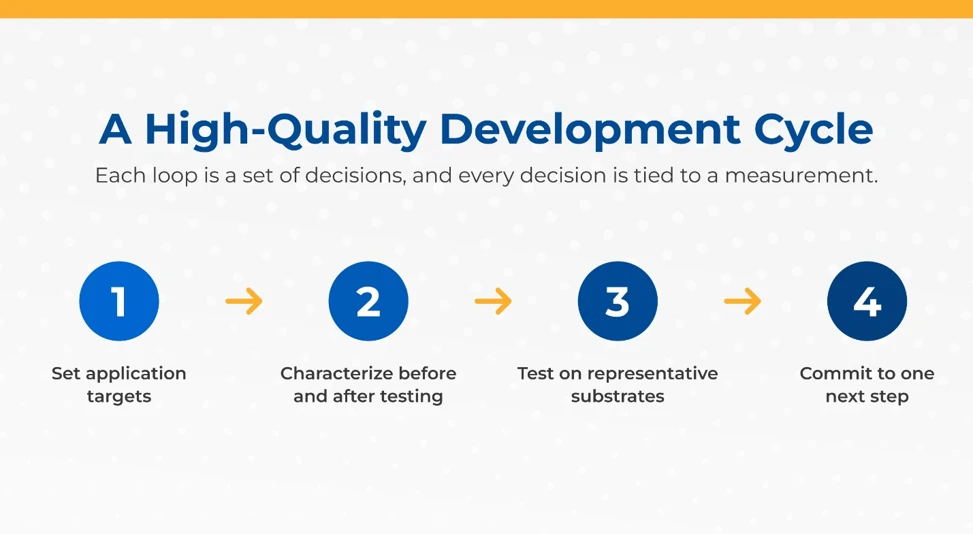
Set Application Targets First
Define conversion or capture efficiency, durability, pressure drop, and cost per part before the first coated sample is made. Clear targets turn test results into decisions.
Characterize Before And After Testing
Characterizing the material before and after each test allows changes in performance to be traced to a cause, such as sintering, poisoning, washcoat loss, or phase change. Catalyst characterization and testing done this way turns each cycle into a learning cycle.
Test Coated Samples On Representative Substrates
Coated samples should be tested on representative substrates under conditions close to the application. The closer the test environment is to the operating environment, the more each cycle reduces uncertainty.
Commit To One Next Step
Use the results to choose a single next step: adjust the formulation, change the coating process, or move to a larger scale. Clear decision points keep loops short, which allows more learning in the same amount of time.
Where Development Cycles Slow Down
In catalyst scale-up, much of the lost time comes from how the work is organized:
- Separate vendors for formulation, analysis, testing, and coating, each with its own queue and lead time
- Data arriving in different formats that must be reconciled before it can inform a decision
- Coating considered late in the program, after the formulation has been locked
- Rework when the production method changes the material
The last point is well documented. In the U.S. Department of Energy report “The Engineering of Catalyst Scale Up,” catalyst performance at intermediate scale was affected when a commercial formulation replaced the lab-prepared material. Manufacturing constraints act as a variable in the experiment, which is why it helps to bring them into the loop before pilot scale.
How CDTi Raises the Quality and Speed of Each Cycle
CDTi brings catalyst development, analytical characterization, testing, coating, and scalable manufacturing together under one team. Results from each step feed directly into the next without a handoff between companies. This shortens the time between hypothesis and evidence and avoids introducing new variables by changing suppliers mid-program.
Catalyst And Formulation Development
CDTi’s catalyst engineering work covers the full development process, from formulation and material characterization through performance testing, optimization, and production-scale implementation. The end application informs the formulation from the start.
Analytical Characterization And Testing
CDTi provides full characterization, formulation optimization, and rapid prototyping, so each iteration produces results that can be traced to a cause.
Coating On The Application Substrate
CDTi’s coating technology covers metallic, ceramic, fibrous, foam, silicon carbide, and honeycomb monolith substrates in round, square, cylindrical, or custom geometries. Catalyst coating and sorbent coating can be applied to CDTi substrates or to substrates supplied by the customer.
Scale-Up And Production
CDTi is ISO 9001 and ISO 14001 certified and has coated more than 14 million catalyst substrates. The production method is well understood before it has a chance to become a constraint.
One Team from Formulation to Production
CDTi handles catalyst development, characterization, testing, coating, and manufacturing in-house. Data moves directly from one step to the next, which shortens each development cycle and keeps variables under control.
Using Data to Manage Material Cost
Well-designed development loops also help manage material cost, particularly through precious metal optimization. Testing coated, application-representative samples shows where performance begins to drop as precious metal loading is reduced. That evidence supports lowering platinum content without losing performance as a sound engineering decision.
Applications That Benefit from Early Integration
Programs that benefit from bringing coating and manufacturing into the development loop early include emissions control, methane abatement, carbon capture and direct air capture, sulfur adsorption, and industrial oxidation and reduction processes. CDTi supports these and related applications across power generation, industrial, mining, marine, and on- and off-highway markets.
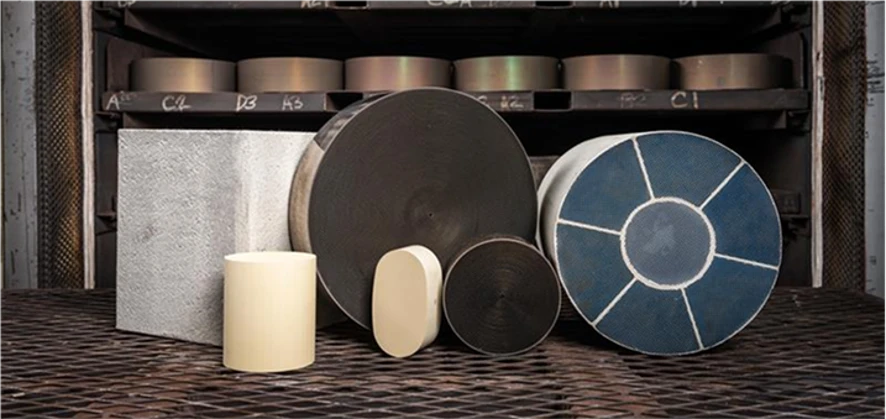
Programs outside these categories can be developed as custom solutions, including fuel borne catalysts, direct air capture sorbent-coated monoliths, and methane abatement catalysts.
Build the Evidence Earlier
Better products come from faster, higher-quality learning cycles, with each decision grounded in data collected under conditions close to the final application. Data-driven product development with an integrated partner shortens the time between hypothesis and evidence, so more of the learning happens while the design can still change.
If you have a catalyst, sorbent, or other functional material in development, talk with CDTi about coating, testing, and scale-up.