
A natural gas engine’s combustion strategy shapes the exhaust before it ever reaches the catalyst. Rich, stoichiometric and lean burn engines produce different temperatures, oxygen levels and emissions profiles. Those differences determine what the catalyst system needs to accomplish.
CDTi develops catalyst technologies for both rich and lean natural gas applications. The work starts with the engine and the conditions it produces, then moves into catalyst chemistry, coating, substrate selection and performance over time.
Efficiency and Emissions Tradeoffs
Lean burn engines operate with excess air and can achieve high fuel efficiency. Lower combustion temperatures also help reduce NOx formation inside the engine.
The exhaust still contains oxygen, though, which changes the options available downstream. Conventional three-way catalyst technology can’t provide the same NOx reduction it can under stoichiometric conditions. Lean burn natural gas engines can also produce higher methane slip.
Rich and stoichiometric engines operate much closer to the stoichiometric air to fuel ratio. That exhaust chemistry supports three-way catalysis, allowing NOx reduction and the oxidation of CO and hydrocarbons within the same catalyst system.
Neither approach removes the need for emissions control. It changes the chemistry the catalyst has to work with.
What is a three-way catalyst?
A three-way catalyst converts three major exhaust pollutants at the same time: hydrocarbons, carbon monoxide, and nitrogen oxides. It oxidizes hydrocarbons and CO while reducing NOx.
Methane Slip Adds Another Challenge
Methane is more difficult to oxidize than many other hydrocarbons because of its chemical stability. Conversion depends on catalyst formulation, but chemistry alone is not enough. Exhaust temperature, methane concentration, oxygen level, and space velocity all play a role.
Lean burn engines can make methane control more demanding. Methane slip may be higher, and oxidation becomes more difficult as exhaust temperatures fall. Unlike rich or stoichiometric engines, which can support three-way catalyst systems, lean burn engines typically require oxidation catalyst technology designed to operate in oxygen-rich exhaust.
Those conditions also change during operation. Load can alter temperature, flow and exhaust composition. Catalyst performance therefore needs to hold across the engine’s duty cycle rather than at a single steady operating point.
CDTi develops oxidation catalyst technology for lean burn natural gas engines with those operating conditions in mind.
Why is methane slip harder to control in lean burn engines?
Methane slip can be harder to control in lean burn engines because the exhaust contains excess oxygen and may run at lower temperatures. Methane is chemically stable, so conversion depends on catalyst design, exhaust temperature, oxygen level and duty cycle.
Three-Way Catalysis for Rich and Stoichiometric Engines
Rich and stoichiometric operation creates the exhaust environment needed for three-way catalysis. CDTi’s technology is used to control NOx, CO, hydrocarbons and VOCs in these natural gas engine applications.
Lambda control is critical. Oxidation and reduction reactions depend on maintaining the required air to fuel ratio, and conversion can change when the exhaust moves outside that window. Methane can be especially sensitive to those changes.
Formulation has to account for the engine conditions as well. Methane does not respond like more easily oxidized hydrocarbons. Precious metal composition and loading need to be considered along with temperature, space velocity and catalyst aging.
This is where engine calibration and catalyst development come together. The catalyst has to be designed for the exhaust it will actually see.
Lean Burn Requires a Different Aftertreatment Strategy
Excess oxygen in lean exhaust rules out the same three-way NOx reduction approach used under stoichiometric conditions.
Oxidation catalysts can control methane, CO, VOCs and formaldehyde. CDTi develops this technology for lean burn natural gas applications. Some systems may also require a separate NOx control technology such as selective catalytic reduction.
Methane conversion remains one of the harder parts of the system. Temperature changes, water vapor and contaminants can all influence activity.
Formaldehyde deserves attention too. It can be present in natural gas engine exhaust and can also form during methane oxidation. Evaluating the catalyst only on methane conversion can miss part of the emissions picture.
Sulfur, Water and Temperature Can Change Catalyst Performance
Fresh catalyst performance is only one measure of success. Activity can change as the catalyst accumulates operating hours.
Water vapor can inhibit methane oxidation, especially at lower temperatures. Sulfur presents a separate durability problem. Sulfur compounds can build up on methane oxidation catalysts and reduce access to active sites.
CDTi’s methane abatement technology addresses sulfur before it reaches the methane oxidation catalyst. Exhaust first passes through a proprietary sulfur adsorber. The downstream catalyst then handles methane conversion.
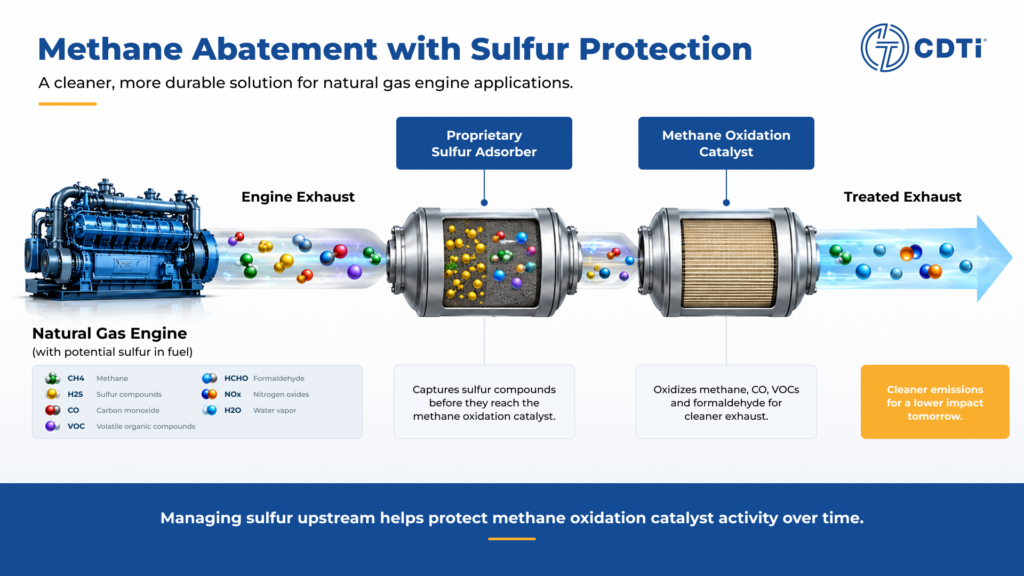
Protecting the methane oxidation catalyst from sulfur helps preserve activity over time. Temperature still sets an important boundary. Lower exhaust temperatures make methane conversion more difficult, so the engine’s load profile and duty cycle remain part of the catalyst design problem.
Matching Catalyst Design to the Engine
Rich or lean classification gives only part of the information needed to develop the catalyst system. The exhaust profile fills in the rest. Temperature and lambda define the reaction environment. Oxygen concentration and pollutant levels affect catalyst chemistry. Flow and space velocity influence catalyst volume and substrate requirements.
Then the design has to survive service. Thermal aging, water and sulfur exposure can all reduce catalyst activity. Packaging limits available volume and affects substrate geometry and pressure drop. Precious metal loading has to deliver the required activity within those constraints.
The variables interact. A substrate change can alter flow. Coating characteristics affect catalyst distribution and loading. More precious metal may increase activity, but it cannot correct an exhaust temperature or gas composition that falls outside the catalyst’s effective range.
How do rich and lean burn engines affect catalyst choice?
Rich and stoichiometric engines can support three-way catalysts for NOx, CO, and hydrocarbons. Lean-burn engines usually require oxidation catalysts for methane, CO, VOCs, and formaldehyde, with separate NOx control when needed.
CDTi brings formulation, analytical characterization, reactor testing, aging, coating development and production together during development. That allows performance to be evaluated early and carried into a coating process that can scale for production.
How CDTi Supports Rich and Lean Burn Applications
Different engines call for different catalyst paths.
CDTi offers three-way catalyst technology for rich and stoichiometric natural gas engines and oxidation catalyst technology for lean-burn applications. Its methane abatement approach adds sulfur management ahead of the oxidation catalyst when sulfur exposure threatens long term methane conversion.
Some projects can begin with an existing CDTi catalyst technology. Others require a formulation developed around a specific application.
CDTi can characterize materials, test catalyst activity under representative gas conditions, conduct aging studies and develop the coating process needed for production. That range of capabilities is useful because engines within the same combustion category can still produce very different temperature profiles, exhaust compositions and duty cycles.
Looking at the Complete Emissions System
Rich and lean burn engines place different demands on the catalyst system.
Lean combustion can deliver high thermal efficiency and lower engine out NOx, while methane oxidation becomes more challenging and downstream NOx control may require another technology.
Rich and stoichiometric operation supports three-way catalysis for several pollutants within one catalyst system. Its performance depends on air to fuel ratio control, exhaust conditions and the catalyst formulation selected for the application.
CDTi develops catalyst solutions with those variables considered together. The engine, exhaust chemistry, catalyst formulation, coating and substrate all influence the result.
If you are evaluating catalyst requirements for a rich, stoichiometric or lean burn natural gas engine, contact CDTi to discuss your application.